
Key takeaways
- How much the mixed approach reduces reporting depends on the business model. EU-related impacts include the whole value chain of products sold into the EU, so exporters still report much of their upstream activity, and globally integrated groups may struggle to separate EU impacts at all.
- For integrated groups, eligibility depends on whether allocation keys are accepted. Allocation keys are the basis, usually a ratio such as revenue or headcount, for splitting shared metrics. The draft requires them to measure EU-related metrics, but does not say whether they can satisfy the paragraph 29 eligibility test. EFRAG may tighten the test or make it fully flexible, and has not decided.
- The strict paragraph 29 test is deliberate. EFRAG wants EU-related impacts to be identifiable from evidence an auditor can check.
- Own workforce may have to be reported globally, even under the mixed approach.
- Prepare now. Start materiality from the EU nexus, build the paragraph 29 evidence, document allocation keys by metric and model own workforce globally, so you can decide quickly once the standard is final.
ESRS-40a timeline and EFRAG's outreach events
EFRAG published the ESRS-40a exposure draft on 23 July and launched a 100-day public consultation which closes on 31 October. A field test with 42 companies is running alongside it.
In September, EFRAG took the exposure draft on the road. I followed five sessions:
- Mexico, jointly organised with CINIF (14 September);
- United States, jointly organised with AmCham EU (17 September);
- Brazil, jointly organised with Comitê Brasileiro de Pronunciamentos de Sustentabilidade (21 September);
- New Zealand and Australia, jointly organised by the XRB (22 September);
- and Canada, jointly organised by the CSSB (25 September).
I compared them with EFRAG's launch webinars on 22 July.
Who is in scope of ESRS-40a, and what are the reporting options?
ESRS-40a is the standard non-EU groups will use to report their impacts under Article 40a of the Accounting Directive. A group is in scope if it has:
- more than €450 million of EU net turnover in each of the last two consecutive financial years;
- and at least one EU subsidiary or branch with net turnover above €200 million in the preceding financial year.
Reporting applies to financial years starting on or after 1 January 2028, with first reports due in 2029. EFRAG's preliminary estimate is that around 1,200 groups are in scope, roughly a third of them headquartered in the US, the largest single group.
ESRS-40a covers impacts only, not risks and opportunities. A non-EU parent in scope has three ways to report:
| Option | What is reported | Key point |
|---|---|---|
| Global approach (default) | All material impacts, for all topics, across the whole group worldwide | The starting position under ESRS-40a |
| Mixed approach (optional) | Climate globally; for other topics, only EU-related impacts, chosen by topic, sub-topic or group of impacts | Added at the European Commission's request. Only available where the paragraph 29 test is met (see below) |
| Full ESRS (voluntary) | The double-materiality ESRS used by EU companies: impacts plus risks and opportunities, globally | Lets EU subsidiaries already in CSRD scope use the subsidiary exemption instead of reporting separately |
What is the ESRS-40a mixed approach?
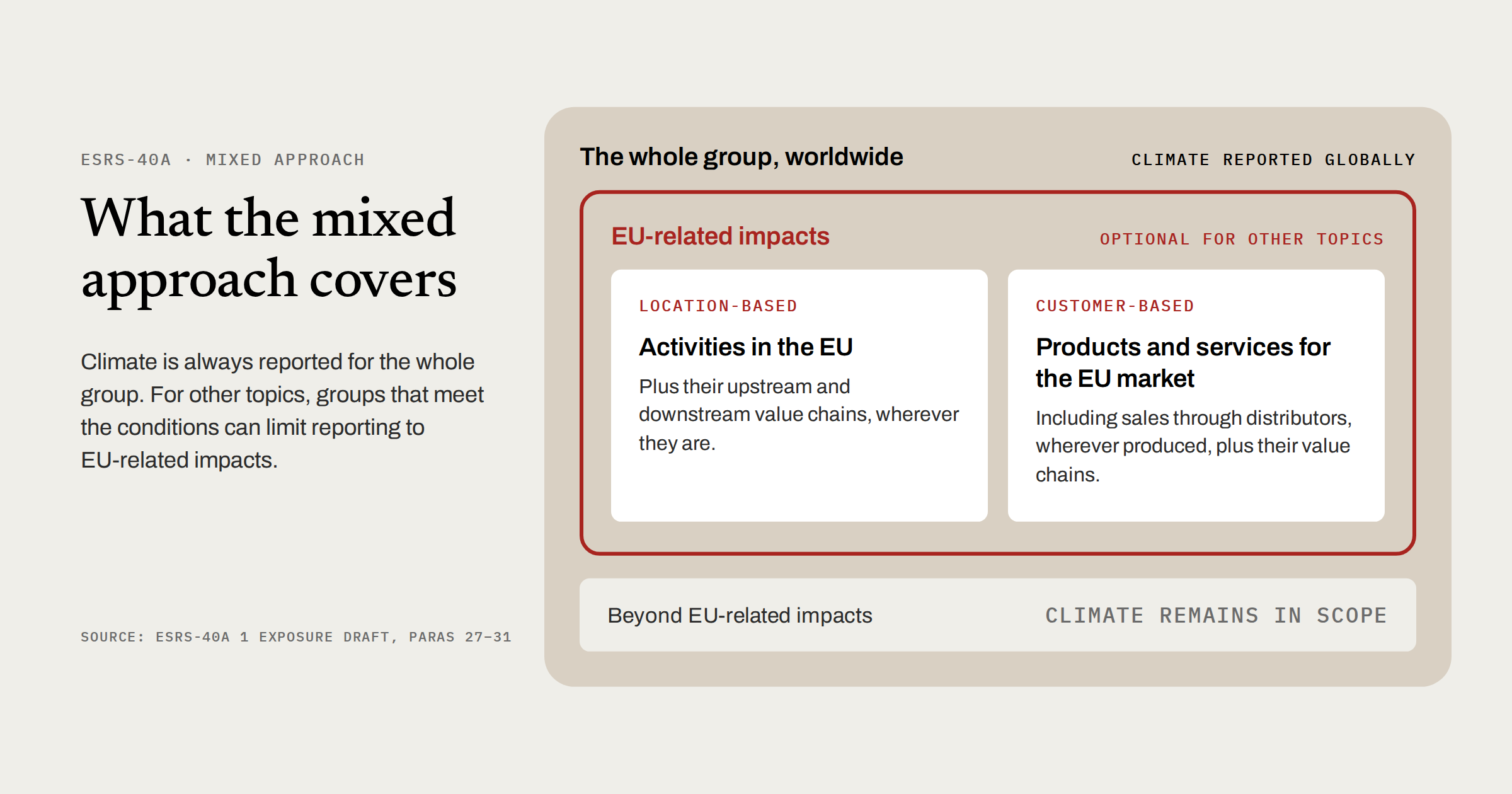
Under the mixed approach, climate is always reported globally, but for other topics a company may limit reporting to EU-related impacts.
"EU-related" has two parts, and both apply:
- impacts of the company's EU operations and their value chains; and
- impacts, wherever they arise, connected to products and services sold, or reasonably assumed to be sold, into the EU.
| Part | What it covers | Example |
|---|---|---|
| Location-based (para 28(b)) | Impacts of the company's activities in the EU, including their upstream and downstream value chains | A US manufacturer's plant in Germany: its emissions to air, water use and the people who work there |
| Customer-based (para 28(a)) | Impacts anywhere in the value chain linked to products and services sold, or reasonably assumed to be sold, into the EU, including through distributors | A New Zealand dairy exporter selling cheese into Europe: upstream impacts on the New Zealand farms and in the factories that produce it |
Why the ESRS-40a mixed approach is controversial
The mixed approach was added at the European Commission's request. The case for it is proportionality: the reporting burden should match the extent of a group's link to the EU.
ESRS-40a applies because a group has significant business in the EU, so the mixed approach lets it report the impacts connected to that business, rather than every impact across its worldwide operations.
For a group whose EU business is a small share of its global activity, that could substantially cut the effort and cost of reporting.
EFRAG was sceptical. The Basis for Conclusions records that its Sustainability Reporting Board would not have proposed the option on its own initiative, citing risks to the level playing field, relevance, comparability and implementation.
Groups with a separate EU business are likely to benefit most from the mixed approach
The mixed approach was one of the most discussed ESRS-40a topics and featured in all five sessions.
The key point is that how much the mixed approach reduces reporting depends on a group's business model.
The EU-related boundary includes the global value chain
During the New Zealand and Australia session, Fonterra, New Zealand's largest dairy cooperative and one of the world's biggest dairy exporters, said the mixed approach was unlikely to be highly relevant to its own reporting or to most New Zealand companies.
As exporters, "it would be difficult to argue that impacts occurred earlier in our supply chain" on New Zealand farms and in New Zealand factories "were not material when the goods are being sold into Europe." EFRAG confirmed the mixed approach would still apply, but it would capture those upstream impacts.
In the Mexico session, EFRAG made the same point more broadly: "regardless whether you do global or mixed approach, the value chain is global." A factory in Mexico that makes products for the EU is EU-related, and so are the upstream impacts linked to those products, wherever they occur.
Integrated groups struggle to separate EU impacts
Brambles, the Australian pallet-pooling group behind CHEP, described a different problem. Its business model is "globally consistent", so separating European impacts is not really possible in practice. Its expectation was a full set of ESRS reporting at group level.
Amazon Web Services, speaking for AmCham EU, made the same point for integrated groups. They have no EU-dedicated product lines, supply chains or data systems, and their workforce, emissions, water and waste data are collected globally or regionally.
In contrast, JPMorgan called the mixed approach "the most workable option" but asked for a sharper boundary: products and services provided to direct clients incorporated in the EU, through an EU subsidiary or branch. ConocoPhillips, a field-test participant, said it would be workable for them.
The sessions suggest a pattern: groups whose EU-related impacts are easy to identify are best placed to benefit, while exporters and integrated groups are likely to gain less.
Materiality starts from the EU nexus
The Mexico session also clarified how materiality works under the mixed approach. Asked whether a company should assess its impacts globally and then filter out the EU-related ones, Chiara Del Prete, who chairs EFRAG's Sustainability Reporting Technical Expert Group, said the standard "assumes that you start from the EU nexus".
A company first identifies the products and services reasonably assumed to be sold into the EU. It then assesses materiality across every jurisdiction where its value chain may be affected, including outside Europe.
For integrated groups, eligibility depends on allocation keys
Allocation, or how a non-EU group separates the EU part of a shared metric (such as a factory's emissions) from the rest, also came up in all five sessions.
What is allocation in ESRS-40a?
Many non-EU groups run shared factories, systems and teams that serve customers both inside and outside the EU. Under the mixed approach, they report only the EU-related part of their impacts, so they need a way to separate that part from the rest.
Allocation is how they do it: they take a shared metric and assign part of it to the EU.
The "allocation key" is the basis that decides how much goes to the EU, usually a ratio. An allocation key could be the share of revenue from EU customers, the share of production volume sold into the EU, or the share of headcount or floor space serving the EU business.
For example, if a factory outside the EU releases 100 tonnes of a pollutant and 30% of its output is sold into the EU, a production-share allocation key could attribute 30 tonnes to EU-related impacts.
Unless a topical standard sets its own rule, the exposure draft requires EU-related metrics to be estimated using the allocation key that best supports a faithful representation.
What is the paragraph 29 test in ESRS-40a?
A group can only use the mixed approach at all if it passes a test in paragraph 29 of ESRS-40a 1. It must be possible to make a "meaningful identification" of its EU-related impacts, in line with how its operations, products and value chains are structured or managed.
Essentially, the business must already be organised in a way that shows which impacts relate to the EU. AR 6 provides some examples:
- a separate EU business segment;
- products or services designed specifically for the EU market;
- separate management of EU-related impacts; or
- value chains dedicated to products and services sold into the EU.
What it does not say is whether allocation can satisfy the paragraph 29 test, and so make a company eligible for the mixed approach. AmCham EU asked EFRAG to confirm that it can, even where a group has no dedicated EU structures.
The answer matters because, for groups whose sites and systems serve both EU and non-EU markets, allocation may be the only way to qualify. Without it, they would have to report globally.
Can non-EU groups with shared operations rely on allocation keys to use the mixed approach?
Stakeholders asked EFRAG this question in several sessions:
- United States (17 September): AmCham EU asked EFRAG to confirm that revenue, headcount and physical-footprint keys can satisfy paragraph 29, even without dedicated EU structures.
- New Zealand and Australia (22 September): responding to Brambles, Chiara Del Prete said the draft "doesn't explicitly say that you can use them, but doesn't explicitly exclude" them. She added that the conditions are examples and that "the standard is intentionally principle-based".
- Canada (25 September): an attendee asked whether EFRAG would issue guidance on allocation keys. EFRAG replied that the mixed approach text may need strengthening in one of two directions:
- Tighten: make the conditions strict, so only groups with a genuinely separate EU business or product can use the mixed approach.
- Flex: make the approach fully flexible, so groups can allocate shared impacts using conventional allocation keys.
Here is what each route would mean for integrated groups:
| If EFRAG tightens | If EFRAG flexes | |
|---|---|---|
| The rule | No mixed approach "unless you have separate business or product" | "Completely flexible": conventional allocations accepted |
| Integrated groups | Fail the test, so report globally or opt for full ESRS | Split shared impacts with a documented key and report only the EU share |
| Challenges | Potentially little reduction in reporting for groups like Brambles: a globally consistent business model makes EU-related impacts hard to separate, so stricter conditions could mean global reporting | Due to the use of different keys, metrics may be less comparable across companies, and people-related impacts don't split meaningfully: counting 30% of a workplace injury as EU-related "doesn't make sense", as EFRAG put it |
The draft is strict by design. In the Mexico session, Chiara Del Prete explained that EFRAG's Sustainability Reporting Board "decided to go for a clear conditionality", so that EU-related impacts can be identified from evidence, "also for the purposes of an audit". She acknowledged that "it may sound restrictive" and said the consultation asks whether the condition is feasible.
EFRAG would not say which route it will take before seeing the field-test results, and stressed that no decision has been taken.
Own workforce may have to be reported globally, even under the mixed approach
Under the customer-based part of the EU-related definition (products and services sold into the EU), the EU-related workforce also includes non-EU staff involved in producing EU-bound goods and services, including support functions such as procurement and marketing. AmCham EU warned that for integrated groups, this could pull in much of the global workforce. It proposed focusing on sites dedicated, or predominantly dedicated, to the EU market.
EFRAG replied that impacts on people do not divide neatly. Counting 30% of an injury or 30% of training hours "doesn't make sense". EFRAG added that, because human rights include the fundamental ILO conventions, own workforce "probably makes sense" as global, and asked whether employees in different countries should have the same baseline.
This is not a new position. The Basis for Conclusions notes that a significant minority of EFRAG's technical experts wanted own workforce reported globally by default.
In the Mexico session, EFRAG said it had been "torn" over whether to require an EU/non-EU breakdown of own-workforce metrics, such as health and safety or the gender pay gap, or to accept a combined figure for the EU and non-EU employees covered by the mixed approach, which companies can disaggregate where it helps faithful representation. It also accepted that a company may use a different allocation basis for different metrics.
How non-EU groups can prepare for the mixed approach
The mixed approach is not settled. EFRAG may tighten or flex it after the consultation and field test, and the first reports cover financial years starting in 2028. Groups that start preparing now will be ready to decide quickly whether to use it, whichever way the final standard goes.
Test the mixed approach against your own structure
Map where your products, sites, support functions and data actually sit. Then test it under the two directions EFRAG described: strict conditions, and flexible allocation.
Start materiality from the EU nexus
Identify your activities in the EU and the products and services reasonably assumed to be sold into the EU, then trace their impacts through the whole value chain, as EFRAG described in the Mexico session. This shows early how much of your value chain the mixed approach actually removes. For exporters, it may be very little.
Build the paragraph 29 evidence now
EFRAG wants EU-related impacts to be identifiable "also for the purposes of an audit". Document how your operations, products and value chains are structured and managed, including any EU segments, EU-specific products or dedicated value chains.
Choose and document allocation keys by metric
The draft requires a key that best supports a faithful representation of EU-related impacts. Record why each key fits the impact it measures, and explain where different metrics use different keys.
Model own workforce globally
EFRAG's comments suggest own workforce may have to be reported globally, even under the mixed approach. Model that scenario before committing to the mixed approach for S1.
Next steps in EFRAG's process
EFRAG presents field-test information at its public board meeting on 7 October. The consultation closes on 31 October. Technical advice goes to the Commission in early 2027.
EFRAG also held sessions in Korea, Japan and the UK, which aren't covered here. I'll update this analysis as those recordings become available.
Frequently asked questions
When does ESRS-40a apply?
ESRS-40a applies to non-EU groups with more than €450 million of EU net turnover in each of the last two consecutive financial years and at least one EU subsidiary or branch with net turnover above €200 million in the preceding financial year. Reporting starts with financial years beginning on or after 1 January 2028, with first reports due in 2029. The standard is still an exposure draft, and EFRAG's consultation closes on 31 October 2026.
Does the ESRS-40a mixed approach apply to climate?
No. Under the exposure draft, climate impacts are always reported globally. The option to limit reporting to EU-related impacts applies only to other topics, and can be used by topic, sub-topic or group of impacts.
What is the ESRS-40a paragraph 29 test?
For topics other than climate, paragraph 29 of ESRS-40a 1 allows the mixed approach only where a group can make a "meaningful identification" of its EU-related impacts, in line with how its operations, products and value chains are structured or managed. Examples include a separate EU segment, EU-specific products, separate management of EU-related impacts or dedicated EU value chains.
Can allocation keys be used under the ESRS-40a mixed approach?
Allocation keys are generally required to estimate EU-related metrics, unless a topical standard sets its own rule. Whether they can also satisfy the paragraph 29 test is not settled. The exposure draft neither allows nor excludes it, and EFRAG has said it may either tighten the conditions or make them fully flexible.
Does own workforce have to be reported globally under ESRS-40a?
Not under the exposure draft as written, but it may be. In the outreach sessions, EFRAG said own workforce "probably makes sense" as global, and a significant minority of its technical experts wanted it reported globally by default.

Share this article