

This article is for early adopters of the revised ESRS and for Wave 2 companies (including non-EU groups whose EU subsidiaries fall into scope) preparing a practice report for FY2026.
Key takeaways
- Non-material information now stays out of the statement. The European Commission changed "may omit" to "shall not disclose" late in the process.
- Three narrow routes remain: other legislation, frameworks such as GRI and SASB, and specific users. Anything included this way must be labelled and listed in IRO-2.
- Non-material data for rating agencies stays out. They aren't on the revised ESRS list of users, and the analysts they resemble were removed from it. Data for lenders, investors and key customers can go in.
- Early adopters and Wave 2 practice reports should test this now. Companies staying on the 2023 ESRS for FY2026 keep the old regime.
What do the revised ESRS say about non-material information?
Under the revised ESRS, an undertaking "shall not disclose" non-material information prescribed by an ESRS datapoint, or in its entity-specific disclosures (ESRS 1, para 24). Under the 2023 ESRS, an undertaking "may omit" a non-material metric datapoint that isn't needed to meet the disclosure requirement's objective (ESRS 1 (2023), para 34(b)). The qualitative characteristics already said concise disclosures "shall only include material information" (ESRS 1 (2023), QC 17), but there was no explicit ban.
The change came late. EFRAG's December 2025 advice said non-material information was "not required". The Commission's May 2026 draft made it "shall not disclose", and the 3 July 2026 delegated act kept it.
The Commission's Omnibus proposal provides the rationale: to ensure undertakings report only material information, and to reduce the risk that assurance providers inadvertently push them to report more than is necessary (quoted in EFRAG's Basis for Conclusions, BC184).
As EFRAG has pointed out, the information materiality filter was not well understood in FY2024 reporting, and some preparers used the IG 3 datapoint list as a checklist (Basis for Conclusions, BC183). But information you have can still be non-material. The test is whether omitting, misstating or obscuring it could reasonably be expected to influence users' decisions (ESRS 1, para 23).
The "shall not disclose" rule is also part of fair presentation, which is judged across the sustainability statement as a whole, not datapoint by datapoint (ESRS 1, paras 3 and 21, and AR 6). AR 6 of ESRS 1 says that review can lead you to add entity-specific information, or to take out information that is not material under ESRS 1, para 24.
The test for including non-material information
Under section 8.2 of ESRS 1 (paras 107–108), non-material information can only be included when it:
- stems from other legislation that requires you to disclose sustainability information;
- stems from generally accepted standards or frameworks, such as GRI or SASB; or
- is needed to meet the data demands of a specific user.
"User" is a defined term in ESRS 1, para 4, and the glossary: investors, lenders and other creditors, plus business partners, social partners such as trade unions, civil society and NGOs.
Bear in mind that including non-material information has a price. Anything inside the statement is within the assurance engagement.
How to label and place non-material information
Non-material information included under ESRS 1, paras 107–108, is called supplementary information. It must be identified as not resulting from the materiality assessment, be a faithful representation and not obscure material information (ESRS 1, para 109). Information from other legislation or a framework must also reference its source (ESRS 1, para 107).
Supplementary information must also be listed in IRO-2 (ESRS 2, para 37(e)). Headings, paragraph titles or the content index can be used to identify it (ESRS 2, AR 29).
Graphic 2 shows four placement options. ESRS 1, para 111, allows sub-parts and appendices; placing items inline, flagged by a heading or paragraph title, is our reading of ESRS 2, AR 29. Inline suits one or two items next to the related disclosure, a sub-part several items on one topic, and an appendix larger blocks such as SASB metrics; cross-refer to it from the related topic. A GRI content index can sit in an appendix as a mapping table (ESRS 1, para 111(b)).

Which non-material information can stay in, and which stays out?
The table applies the test to common requests and shows where each can go.
| Example | In or out? | Why | Where it can go |
|---|---|---|---|
| Non-material data for an ESG rating agency | Out | Rating agencies aren't users, and analysts were removed from the definition (BC163) | Data book or website |
| Asset manager's SFDR request, e.g. activities negatively affecting biodiversity-sensitive areas, where biodiversity isn't material | Can be in | Investors are primary users | In the statement, labelled |
| KPI in a bank's sustainability-linked loan | Can be in | Lenders are primary users. A KPI chosen under the Sustainability-Linked Loan Principles is often material under ESRS too; if not, the lender's request can bring it in (ESRS 1, para 108) | In the statement, as material information or labelled |
| Car maker's supplier contract requiring assured water withdrawal data, where water isn't material for the supplier | Can be in | Customers are business partners and therefore meet the definition of users | In the statement, labelled |
| GRI content index or SASB industry metrics | Can be in | Generally accepted frameworks; ESRS 1 names GRI | Appendix, referenced and labelled |
| Norwegian Transparency Act account | Can be in | Norway's consumer authority accepts the account in an annual or sustainability report if clearly marked and signed. Practice varies: some companies include the account in their sustainability statement; others publish it separately | In the statement, labelled, or separately. Either way, it must be signed and easy to find on the website, with the management report saying where |
| French vigilance plan | Can be in | French law requires it in the management report, but not necessarily in the sustainability statement | Section after the statement and its assurance report, cross-referenced |
| UK Modern Slavery Act statement | Can be in | The Act requires a signed annual statement. In our reading, it counts as "other legislation" under ESRS 1, para 107(i), which isn't limited to EU law | Material content in S1 to S3; signed statement on the website, linked from the homepage |
For national laws, material due diligence content goes in the topical standards as normal. The Norway and France rows reflect what companies do; the other placements are our reading. Outside the statement, an account needs fewer cross-references and, as it isn't assured with the statement, can carry more context. If you have recurring requests from several users, they might be a sign that the materiality assessment needs another look.
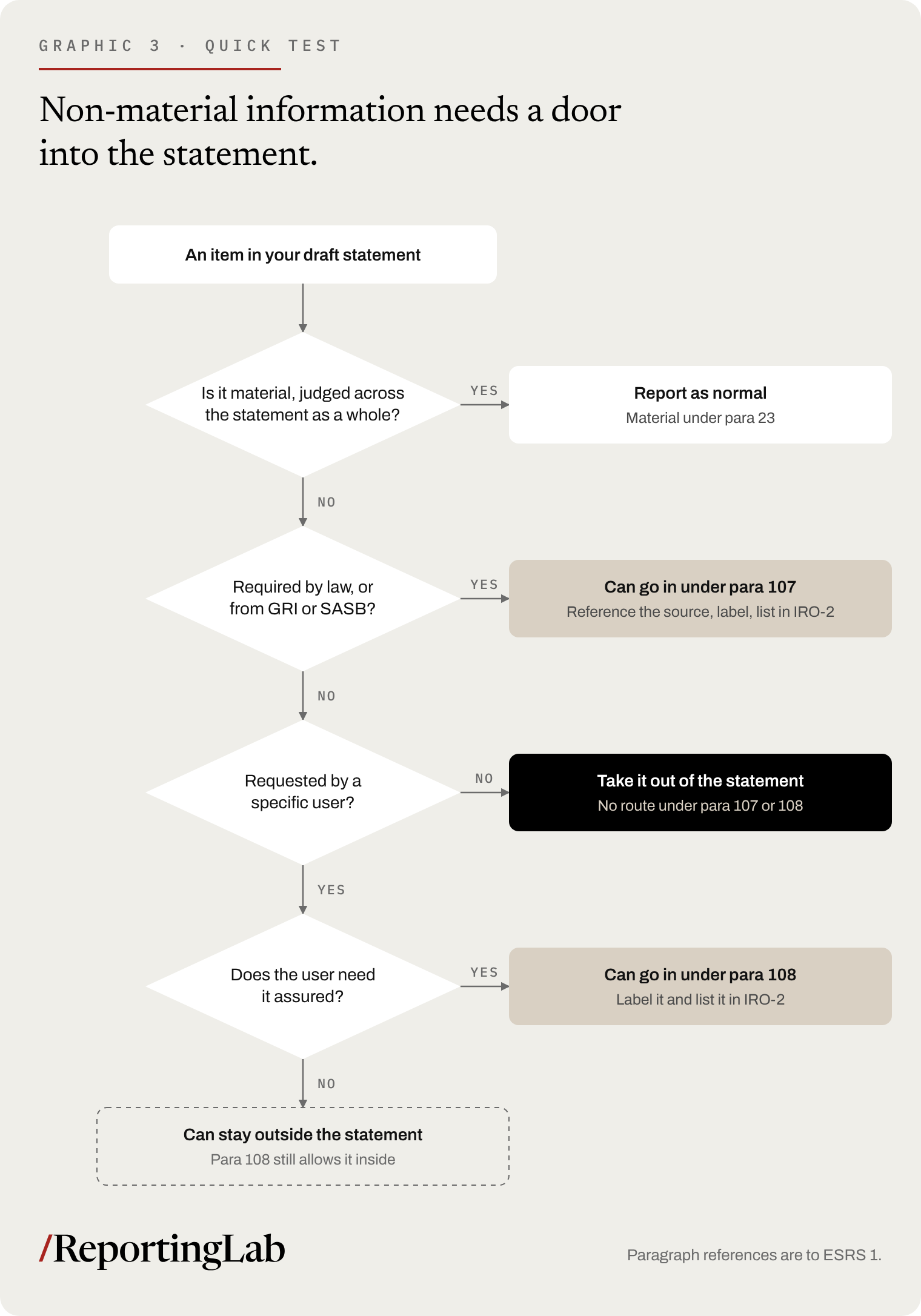
Quick test: can this item stay in your sustainability statement?
Graphic 3 turns the test into four questions, from materiality to whether a user needs the information assured, and shows where each answer leads.
What to do next
In FY2026, the "shall not disclose" rule applies only to early adopters: Wave 1 companies that use the revised ESRS for FY2026 (Delegated Regulation (EU) 2026/1563, Article 2). Wave 1 companies that stay on the 2023 ESRS keep "may omit". Wave 2 companies that remain in CSRD scope, including non-EU groups through their EU subsidiaries, report first on FY2027, so a practice report on FY2026 lets them apply the rules from the start.
- Update the materiality assessment to the revised ESRS 1, which allows a top-down approach (ESRS 1, para 27).
- Start from what you report now. For early adopters, that's last year's report; for Wave 2 companies, their draft or gap analysis. EFRAG's draft mapping links the 2023 datapoints to the revised ones, but it isn't a checklist.
- Test materiality, not applicability. Apply the information materiality filter to the information you have, not only to datapoints that don't apply (ESRS 1, paras 23–24).
- Check which items qualify as supplementary information. Each needs a route under ESRS 1, para 107 or 108. Without one, it comes out.
- Label and list what stays, in place and in IRO-2, and choose where it sits.
- Document your judgements for your assurance provider.
ReportingLab can review your draft for non-material content and set up the labelling and IRO-2 list.
Frequently asked questions about non-material information under the revised ESRS
Does non-material information have to be assured?
If it sits inside the sustainability statement, yes. The assurance engagement covers the statement, and supplementary information must be a faithful representation (ESRS 1, para 109(b)). Information kept outside the statement isn't covered by that engagement, though it can be assured separately.
Can non-material information go elsewhere in the management report?
In our reading, yes. Paragraph 24 of ESRS 1 governs the sustainability statement, not the rest of the management report. The French vigilance plan is the common example: it sits in the management report, often after the sustainability statement and its assurance report.
Can we keep reporting the 2023 "may disclose" datapoints?
Only if the information is material, or comes in through ESRS 1, para 107 or 108. The revised ESRS drop the "may disclose" category, so a former voluntary datapoint needs one of those routes.

Share this article